Expertise
Cable Testing
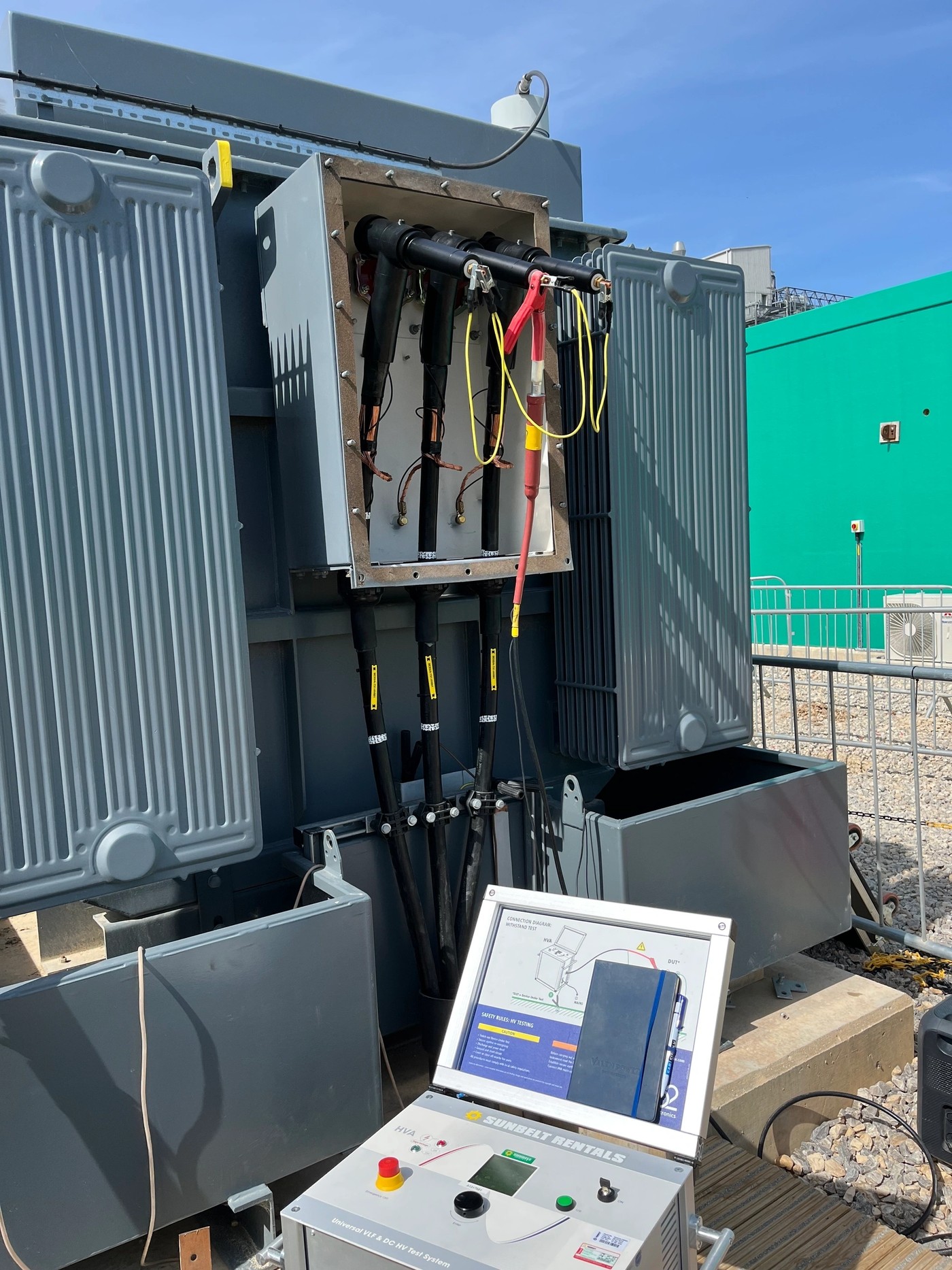
HV cable testing using Very Low Frequency (VLF) equipment for reliable insulation testing on cables up to 33kV, verifying insulation integrity and finding defects before they fail in service.
- Voltage range
- 11kV · 22kV · 33kV
- Coverage
- UK-wide
- Delivered by
- HV commissioning engineers & SAPs
Why VLF rather than DC
DC testing of modern XLPE cable can leave trapped space charge and, in aged insulation, contribute to the very degradation it is trying to detect. Very Low Frequency testing applies an AC waveform at around 0.1Hz, which stresses the insulation in a way that is representative of service conditions while keeping test set size and power demand practical for site work.
The result is a test that finds real defects — water trees, poor joints, incorrectly assembled terminations, mechanical damage from installation — without unnecessarily prejudicing the cable's remaining life.
Diagnostics, not just pass or fail
A withstand test tells you the cable survived. Tan delta and leakage current trending tell you how much margin it has left. On critical circuits, or where a cable is being adopted into a DNO network, that distinction matters: it converts a binary result into an asset management decision.
- New installation acceptance testing before energisation
- After-repair and after-jointing verification
- Periodic condition testing on existing HV circuits
- Sheath integrity testing on newly installed runs
- Phase identification and continuity proving pre-termination
Testing safely on site
HV cable testing is a high-energy activity carried out on assets that often run into occupied buildings. Every test is preceded by isolation, proving dead, earthing at remote ends, exclusion zones at both ends and a documented point of control. Discharge and re-earthing after each test step are part of the method, not an afterthought.
Cable Testing — questions we get asked
- What voltage cables can you test?
- We test HV cables up to 33kV using VLF equipment, covering 11kV, 22kV and 33kV distribution and private network circuits.
- Will VLF testing damage an older cable?
- VLF is significantly less prejudicial than DC testing on polymeric insulation. Test voltage and duration are selected against IEEE 400.2 guidance and cable age, and diagnostics can be used first where condition is unknown.
Related capability
Talk to us about cable testing
Tell us the voltage range, scope and programme dates. A commissioning engineer will come back to you — not a call centre.