
Expertise
Protection Testing
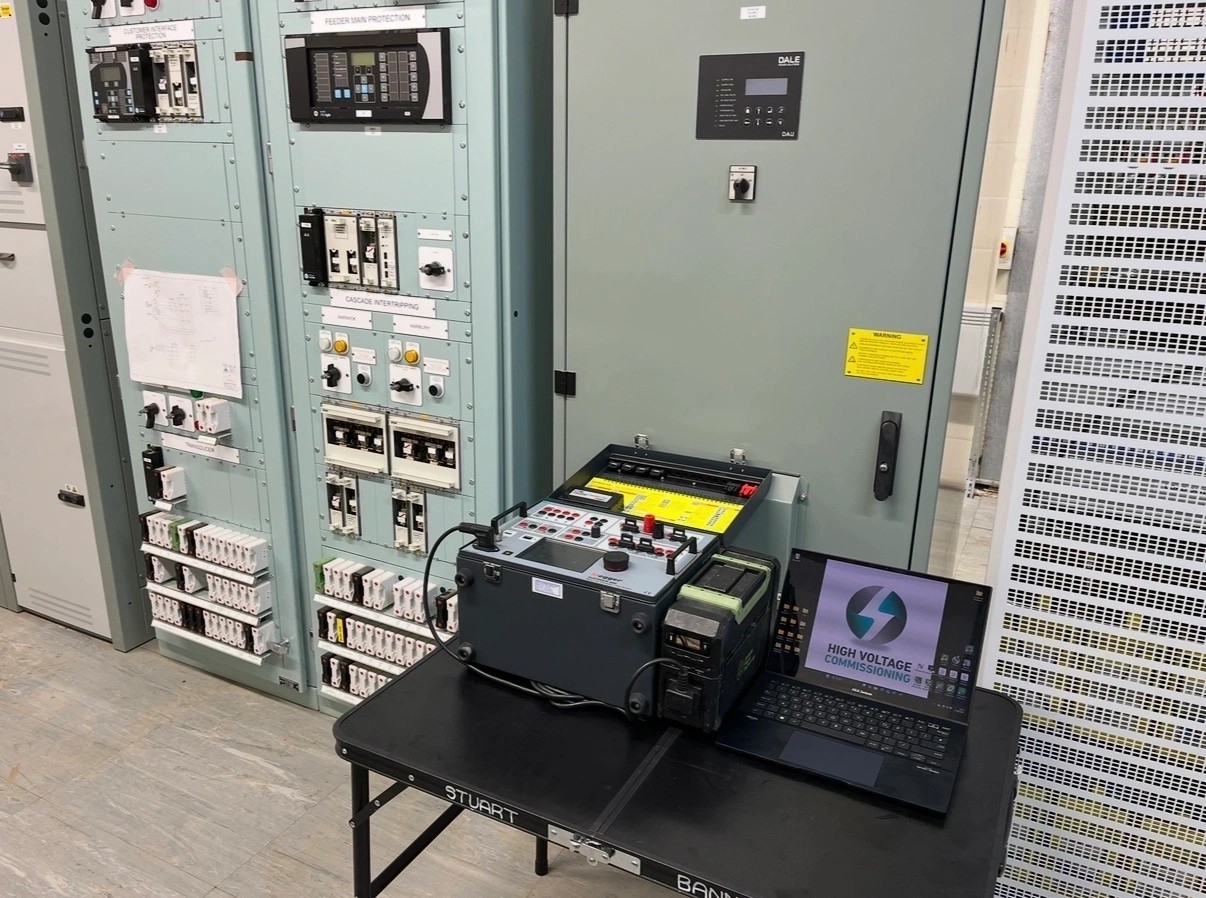
Relay protection testing that proves systems operate accurately and selectively under fault conditions — settings, functionality, timing and trip paths verified end to end.
- Voltage range
- 11kV · 33kV · 66kV · 132kV
- Coverage
- UK-wide
- Delivered by
- HV commissioning engineers & SAPs
Testing the scheme, not just the relay
A relay that passes its own element tests can still fail to clear a fault. What matters is the whole chain: current transformer ratio and polarity, wiring burden, relay logic, output contacts, trip coil, breaker mechanism and the auxiliary supply feeding all of it. We test that chain in sequence so a genuine fault has nowhere to hide.
Secondary injection proves each element — overcurrent stages, earth fault and sensitive earth fault, differential, distance zones, directional decisions, under/over voltage and frequency, arc flash and busbar schemes where fitted — against the approved settings schedule, including timing at multiple multiples of setting rather than a single pick-up check.
Primary injection: where real errors surface
Primary injection is the only test that proves the installed CT circuit, not the drawing of it. Injecting real primary current confirms ratio, polarity, correct phase allocation and that current is arriving at the relay through the intended path with no shorting link or spare core left connected. On differential and busbar schemes it is the difference between a scheme that discriminates and one that trips the wrong circuit under load.
Where protection testing usually goes wrong
The recurring findings we log on UK sites are consistent: settings applied from a superseded revision of the schedule, grading margins that only fail at minimum plant configuration, CT star point earthed at both ends, trip circuit supervision wired to monitor the wrong side of the trip link, and inverse curve types mismatched between upstream and downstream devices. All of them are cheap to fix on a de-energised system and expensive to discover in service.
- Numerical and electromechanical relay testing
- Differential, distance, busbar and interlock schemes
- Arc flash and fast bus tripping verification
- Grading and discrimination proving against the study
- Periodic protection re-testing and maintenance intervals
Protection Testing — questions we get asked
- How often should HV protection be tested?
- Most UK asset owners work to a three to six year interval for numerical relays, with tighter intervals on critical or electromechanical equipment. Testing is also required after any settings change, relay replacement or fault operation.
- Do you test both numerical and electromechanical relays?
- Yes. We test modern numerical platforms and legacy electromechanical relays, including as-found records where existing settings are undocumented.
Related capability
Talk to us about protection testing
Tell us the voltage range, scope and programme dates. A commissioning engineer will come back to you — not a call centre.